When My Messages Go in Order by the Native Id Does Mean They Ate Read?

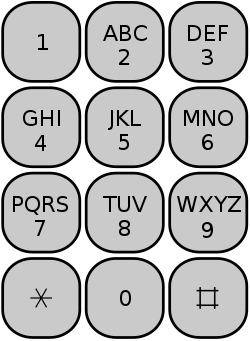
E.161, a common mobile keypad alphabet layout
SMS (Short Bulletin Service) is a text messaging service component of well-nigh telephone, Internet, and mobile device systems. It uses standardized communication protocols that allow mobile devices substitution curt text letters. An intermediary service tin can facilitate a text-to-vocalism conversion to be sent to landlines.[ane]
SMS technology originated from radio telegraphy in radio memo pagers that used standardized phone protocols. These were defined in 1986 as function of the Global System for Mobile Communications (GSM) series of standards.[ii] The first test SMS message was sent on Dec 3, 1992, when Neil Papworth, a test engineer for Sema Group, used a personal computer to send "Merry Christmas" to the telephone of colleague Richard Jarvis.[3] SMS rolled out commercially on many cellular networks that decade and became hugely pop worldwide as a method of text communication.[iv] By the terminate of 2010, SMS was the most widely used information application, with an estimated 3.5 billion active users, or about 80% of all mobile phone subscribers.
The service allows users to send and receive messages of up to 160 characters (when entirely alpha-numeric) to and from GSM mobiles. Although almost SMS messages are sent from one mobile telephone to another, support for the service has expanded to include other mobile technologies, such as CDMA networks and Digital AMPS.[v]
Mobile marketing, a type of directly marketing, uses SMS.[6] According to a 2018 market place research report, the global SMS messaging business was estimated to be worth over US$100 billion, bookkeeping for almost 50 pct of all revenue generated by mobile messaging.[seven]
History [edit]
Initial concept [edit]
Calculation text messaging functionality to mobile devices began in the early on 1980s. The outset action plan of the CEPT Group GSM was approved in December 1982, requesting that "The services and facilities offered in the public switched phone networks and public data networks ... should be available in the mobile system."[viii] This plan included the substitution of text messages either directly betwixt mobile stations, or transmitted via bulletin handling systems in apply at that fourth dimension.[9]
The SMS concept was adult in the Franco-German GSM cooperation in 1984 by Friedhelm Hillebrand and Bernard Ghillebaert.[10] The GSM is optimized for telephony, since this was identified every bit its main application. The cardinal idea for SMS was to use this telephone-optimized organisation, and to transport messages on the signalling paths needed to command the phone traffic during periods when no signalling traffic existed. In this way, unused resource in the system could exist used to transport messages at minimal cost. However, it was necessary to limit the length of the messages to 128 bytes (afterwards improved to 160 seven-bit characters) so that the messages could fit into the existing signalling formats. Based on his personal observations and on analysis of the typical lengths of postcard and Telex messages, Hillebrand argued that 160 characters was sufficient for most brief communications.[eleven]
SMS could exist implemented in every mobile station by updating its software. Hence, a large base of SMS-capable terminals and networks existed when people began to use SMS.[12] A new network element required was a specialized short message service centre, and enhancements were required to the radio capacity and network transport infrastructure to arrange growing SMS traffic.[ commendation needed ]
Early development [edit]
The technical development of SMS was a multinational collaboration supporting the framework of standards bodies. Through these organizations the technology was fabricated freely bachelor to the whole world.[xiii]
The first proposal which initiated the development of SMS was made past a contribution of Germany and France in the GSM group meeting in February 1985 in Oslo.[14] This proposal was further elaborated in GSM subgroup WP1 Services (Chairman Martine Alvernhe, French republic Telecom) based on a contribution from Federal republic of germany. There were also initial discussions in the subgroup WP3 network aspects chaired by Jan Audestad (Telenor). The result was approved by the chief GSM grouping in a June 1985 document which was distributed to industry.[fifteen] The input documents on SMS had been prepared past Friedhelm Hillebrand of Deutsche Telekom, with contributions from Bernard Ghillebaert of France Télécom. The definition that Friedhelm Hillebrand and Bernard Ghillebaert brought into GSM chosen for the provision of a message transmission service of alphanumeric messages to mobile users "with acknowledgement capabilities". The final iii words transformed SMS into something much more than useful than the electronic paging services used at the time that some in GSM might have had in heed.[16]
SMS was considered in the main GSM group as a possible service for the new digital cellular organization. In GSM document "Services and Facilities to be provided in the GSM System,"[two] both mobile-originated and mobile-terminated short messages appear on the tabular array of GSM teleservices.[ citation needed ]
The discussions on the GSM services were concluded in the recommendation GSM 02.03 "TeleServices supported past a GSM PLMN."[17] Here a rudimentary clarification of the iii services was given:
- Curt message mobile-terminated (SMS-MT)/ Indicate-to-Point: the ability of a network to transmit a Short Bulletin to a mobile phone. The message tin be sent by phone or by a software application.
- Short bulletin mobile-originated (SMS-MO)/ Signal-to-Point: the ability of a network to transmit a Brusque Message sent by a mobile telephone. The message tin can be sent to a phone or to a software application.
- Curt message prison cell broadcast.[ citation needed ]
The material elaborated in GSM and its WP1 subgroup was handed over in Spring 1987 to a new GSM body called IDEG (the Implementation of Data and Telematic Services Experts Grouping), which had its offset in May 1987 nether the chairmanship of Friedhelm Hillebrand (German Telecom). The technical standard known today was largely created by IDEG (later on WP4) as the two recommendations GSM 03.40 (the two point-to-point services merged) and GSM 03.41 (prison cell circulate).[ citation needed ]
WP4 created a Drafting Group Message Handling (DGMH), which was responsible for the specification of SMS. Finn Trosby of Telenor chaired the typhoon group through its offset 3 years, in which the design of SMS was established. DGMH had 5 to 8 participants, and Finn Trosby mentions every bit major contributors Kevin Holley, Eija Altonen, Didier Luizard and Alan Cox. The showtime action plan[xviii] mentions for the kickoff fourth dimension the Technical Specification 03.40 "Technical Realisation of the Short Message Service". Responsible editor was Finn Trosby. The kickoff and very rudimentary draft of the technical specification was completed in November 1987.[nineteen] However, drafts useful for the manufacturers followed at a later stage in the menstruation. A comprehensive description of the work in this catamenia is given in.[20]
The work on the draft specification continued in the following few years, where Kevin Holley of Cellnet (now Telefónica O2 Uk) played a leading role. Too the completion of the master specification GSM 03.40, the detailed protocol specifications on the arrangement interfaces too needed to exist completed.[ citation needed ]
Back up in other architectures [edit]
The Mobile Application Role (MAP) of the SS7 protocol included support for the transport of Short Messages through the Core Network from its inception.[21] MAP Phase two expanded support for SMS past introducing a carve up operation code for Mobile Terminated Brusk Bulletin transport.[22] Since Phase 2, there accept been no changes to the Curt Bulletin functioning packages in MAP, although other operation packages have been enhanced to back up CAMEL SMS control.[ commendation needed ]
From 3GPP Releases 99 and 4 onwards, CAMEL Phase iii introduced the power for the Intelligent Network (IN) to control aspects of the Mobile Originated Short Message Service,[23] while CAMEL Phase 4, as role of 3GPP Release five and onwards, provides the IN with the ability to control the Mobile Terminated service.[24] CAMEL allows the gsmSCP to cake the submission (MO) or delivery (MT) of Brusque Messages, route messages to destinations other than that specified past the user, and perform existent-time billing for the use of the service. Prior to standardized CAMEL control of the Short Message Service, IN command relied on switch vendor specific extensions to the Intelligent Network Application Role (INAP) of SS7.[ citation needed ]
Early implementations [edit]
The first SMS message[3] was sent over the Vodafone GSM network in the United Kingdom on 3 December 1992, from Neil Papworth of Sema Group (now Mavenir Systems) using a personal figurer to Richard Jarvis of Vodafone using an Orbitel 901 handset. The text of the message was "Merry Christmas."[25]
The first commercial deployment of a brusque message service center (SMSC) was by Aldiscon role of Logica (now office of CGI) with Telia (at present TeliaSonera) in Sweden in 1993,[26] followed by Armada Call (at present Nextel)[27] in the United states of america, Telenor in Kingdom of norway[28] and BT Cellnet (now O2 UK)[29] afterwards in 1993. All start installations of SMS gateways were for network notifications sent to mobile phones, usually to inform of voice post messages.[ citation needed ]
The outset commercially sold SMS service was offered to consumers, equally a person-to-person text messaging service by Radiolinja (at present function of Elisa) in Finland in 1993. Most early GSM mobile phone handsets did not support the ability to send SMS text letters, and Nokia was the only handset manufacturer whose total GSM phone line in 1993 supported user-sending of SMS text messages. Co-ordinate to Matti Makkonen, an engineer at Nokia at the time, the Nokia 2010, which was released in January 1994, was the first mobile phone to support composing SMSes hands.[30]
Initial growth was slow, with customers in 1995 sending on average only 0.4 messages per GSM customer per month.[31] One cistron in the irksome takeup of SMS was that operators were slow to set up charging systems, especially for prepaid subscribers, and eliminate billing fraud which was possible by changing SMSC settings on private handsets to apply the SMSCs of other operators.[ citation needed ] Initially, networks in the UK only allowed customers to send messages to other users on the same network, limiting the usefulness of the service. This restriction was lifted in 1999.[3]
Over fourth dimension, this effect was eliminated by switch billing instead of billing at the SMSC and past new features within SMSCs to allow blocking of foreign mobile users sending letters through information technology. By the end of 2000, the boilerplate number of messages reached 35 per user per calendar month,[31] and on Christmas Day 2006, over 205 one thousand thousand messages were sent in the UK alone.[32]
Text messaging outside GSM [edit]

SMS was originally designed equally office of GSM, but is now bachelor on a wide range of networks, including 3G networks. Notwithstanding, not all text messaging systems use SMS, and some notable alternative implementations of the concept include J-Phone's SkyMail and NTT Docomo's Brusque Post, both in Nihon. Email messaging from phones, every bit popularized by NTT Docomo'due south i-mode and the RIM BlackBerry, too typically uses standard mail protocols such as SMTP over TCP/IP.[ citation needed ]
SMS today [edit]
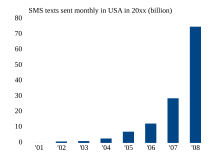
SMS messages sent monthly in the U.Due south. from 2001 to 2008 (in billions)
In 2010[update], 6.1 trillion (6.ane × 1012) SMS text messages were sent,[33] which is an average of 193,000 SMS per second. SMS has become a large commercial industry, earning $114.6 billion globally in 2010.[34] The global average price for an SMS message is U.s.a.$0.11, while mobile networks accuse each other interconnect fees of at least United states of america$0.04 when connecting between unlike phone networks.[ citation needed ]
In 2015, the actual cost of sending an SMS in Australia was establish to exist $0.00016 per SMS.[35]
In 2014, Caktus Group[36] developed the world'south starting time SMS-based voter registration organisation in Libya. Every bit of February 2015 more ane.5 one thousand thousand people have registered using that system, providing Libyan voters with unprecedented access to the democratic procedure.[37]
While SMS is yet a growing market, it is being increasingly challenged by Internet Protocol-based messaging services such as Apple tree's iMessage, Facebook Messenger, WhatsApp, Viber, WeChat (in Cathay) and Line (in Nihon), available on smart phones with data connections.[38] Information technology has been reported that over 97% of smart telephone owners employ alternative messaging services at least once a twenty-four hour period.[39] However, in the U.S. these Cyberspace-based services have not caught on as much,[ timeframe? ] and SMS continues to be highly popular there.
SMS Enablement [edit]
SMS enablement allows individuals to send an SMS bulletin to a business phone number (traditional landline) and receive a SMS in return. Providing customers with the ability to text to a phone number allows organizations to offer new services that evangelize value. Examples include chat bots, and text enabled client service and telephone call centers.[ citation needed ]
Technical details [edit]
GSM [edit]
The Short Message Service—Point to Betoken (SMS-PP)—was originally defined in GSM recommendation 03.40, which is now maintained in 3GPP equally TS 23.040.[40] [41] GSM 03.41 (now 3GPP TS 23.041) defines the Curt Message Service—Cell Broadcast (SMS-CB), which allows letters (advertising, public information, etc.) to be circulate to all mobile users in a specified geographical area.[42] [43]
Messages are sent to a short message service center (SMSC), which provides a "store and forward" mechanism. Information technology attempts to send letters to the SMSC'due south recipients. If a recipient is not reachable, the SMSC queues the message for later retry.[44] Some SMSCs also provide a "forward and forget" selection where transmission is tried only once. Both mobile terminated (MT, for letters sent to a mobile handset) and mobile originating (MO, for those sent from the mobile handset) operations are supported. Message delivery is "best try", then there are no guarantees that a message volition actually be delivered to its recipient, but delay or complete loss of a message is uncommon, typically affecting less than 5 percent of messages.[45] Some providers let users to request delivery reports, either via the SMS settings of almost modern phones, or by prefixing each bulletin with *0#[46] or *N#. All the same, the exact meaning of confirmations varies from reaching the network, to being queued for sending, to being sent, to receiving a confirmation of receipt from the target device, and users are often not informed of the specific blazon of success existence reported.[ citation needed ]
SMS is a stateless communication protocol in which every SMS bulletin is considered entirely independent of other messages. Enterprise applications using SMS as a communication aqueduct for stateful dialogue (where an MO reply message is paired to a specific MT message) requires that session management be maintained external to the protocol.[ citation needed ]
Bulletin size [edit]
Manual of brusk messages betwixt the SMSC and the handset is washed whenever using the Mobile Application Part (MAP) of the SS7 protocol.[47] Messages are sent with the MAP MO- and MT-ForwardSM operations, whose payload length is limited by the constraints of the signaling protocol to precisely 140 bytes (140 bytes * 8 $.25 / byte = 1120 bits).
Short letters can exist encoded using a variety of alphabets: the default GSM seven-bit alphabet, the 8-bit data alphabet, and the sixteen-scrap UCS-2 alphabet.[48] Depending on which alphabet the subscriber has configured in the handset, this leads to the maximum individual brusk bulletin sizes of 160 7-bit characters, 140 eight-bit characters, or 70 xvi-bit characters. GSM 7-scrap alphabet support is mandatory for GSM handsets and network elements,[48] simply characters in languages such as Hindi, Arabic, Chinese, Korean, Japanese, or Cyrillic alphabet languages (e.k., Russian, Ukrainian, Serbian, Bulgarian, etc.) must be encoded using the 16-bit UCS-2 character encoding (meet Unicode). Routing data and other metadata is additional to the payload size.[ citation needed ]
Larger content (concatenated SMS, multipart or segmented SMS, or "long SMS") can be sent using multiple messages, in which case each message will start with a User Data Header (UDH) containing segmentation information. Since UDH is role of the payload, the number of available characters per segment is lower: 153 for 7-scrap encoding, 134 for 8-bit encoding and 67 for 16-chip encoding. The receiving handset is then responsible for reassembling the message and presenting it to the user every bit one long message. While the standard theoretically permits up to 255 segments,[49] x segments is the practical maximum with some carriers,[l] and long messages are oft billed as equivalent to multiple SMS letters. In some cases 127 segments are supported,[51] but software limitations in out of the box Android apps practise non let to ship such a message without converting to MMS offset, one can utilize QKSMS app to ship such a long SMS. Some providers have offered length-oriented pricing schemes for messages, although that type of pricing construction is chop-chop disappearing.[ citation needed ]
Gateway providers [edit]
SMS gateway providers facilitate SMS traffic between businesses and mobile subscribers, including SMS for enterprises, content delivery, and entertainment services involving SMS, e.g. Television voting. Considering SMS messaging performance and cost, as well as the level of messaging services, SMS gateway providers tin be classified as aggregators or SS7 providers.[ commendation needed ]
The aggregator model is based on multiple agreements with mobile carriers to substitution two-way SMS traffic into and out of the operator'southward SMSC, also known as "local termination model". Aggregators lack direct access into the SS7 protocol, which is the protocol where the SMS messages are exchanged. SMS letters are delivered to the operator's SMSC, but not the subscriber's handset; the SMSC takes care of further treatment of the bulletin through the SS7 network.[ citation needed ]
Another type of SMS gateway provider is based on SS7 connectivity to route SMS letters, also known as "international termination model". The advantage of this model is the ability to route data direct through SS7, which gives the provider total control and visibility of the consummate path during SMS routing. This ways SMS messages can be sent straight to and from recipients without having to get through the SMSCs of other mobile operators. Therefore, it is possible to avoid delays and message losses, offer full delivery guarantees of messages and optimized routing. This model is particularly efficient when used in mission-critical messaging and SMS used in corporate communications. Moreover, these SMS gateway providers are providing branded SMS services with masking but after misuse of these gateways most countries's Governments accept taken serious steps to block these gateways.[ citation needed ]
Interconnectivity with other networks [edit]
Message Service Centers communicate with the Public Land Mobile Network (PLMN) or PSTN via Interworking and Gateway MSCs.[ citation needed ]
Subscriber-originated messages are transported from a handset to a service center, and may be destined for mobile users, subscribers on a fixed network, or Value-Added Service Providers (VASPs), also known equally application-terminated. Subscriber-terminated letters are transported from the service center to the destination handset, and may originate from mobile users, from stock-still network subscribers, or from other sources such as VASPs.[ commendation needed ]
On some carriers nonsubscribers can send messages to a subscriber'south telephone using an Email-to-SMS gateway. Additionally, many carriers, including AT&T Mobility, T-Mobile USA,[52] Dart,[53] and Verizon Wireless,[54] offer the ability to do this through their respective websites.[ commendation needed ]
For instance, an AT&T subscriber whose phone number was 555-555-5555 would receive emails addressed to 5555555555@txt.att.net as text messages. Subscribers can easily reply to these SMS letters, and the SMS respond is sent back to the original email address. Sending e-mail to SMS is costless for the sender, but the recipient is subject to the standard delivery charges. Only the first 160 characters of an email message tin be delivered to a phone, and only 160 characters can be sent from a phone. Even so, longer letters may be broken up into multiple texts, depending upon the telephone service provider.[55] [56]
Text-enabled fixed-line handsets are required to receive messages in text format. Nevertheless, messages can exist delivered to non enabled phones using text-to-speech conversion.[57]
Brusque messages can send binary content such equally ringtones or logos, too every bit Over-the-air programming (OTA) or configuration data. Such uses are a vendor-specific extension of the GSM specification and at that place are multiple competing standards, although Nokia's Smart Messaging is mutual. An alternative way for sending such binary content is European monetary system messaging, which is standardized and not dependent on vendors.[ commendation needed ]
SMS is used for M2M (Machine to Car) communication. For case, at that place is an LED display machine controlled past SMS, and some vehicle tracking companies utilize SMS for their information transport or telemetry needs. SMS usage for these purposes is slowly beingness superseded past GPRS services owing to their lower overall toll.[ citation needed ] GPRS is offered past smaller telco players equally a route of sending SMS text to reduce the toll of SMS texting internationally.[58]
AT commands [edit]
Many mobile and satellite transceiver units support the sending and receiving of SMS using an extended version of the Hayes control prepare. The extensions were standardised as part of the GSM Standards and extended as part of the 3GPP standards process.[59]
The connexion between the terminal equipment and the transceiver tin can be realized with a series cable (due east.g., USB), a Bluetooth link, an infrared link, etc. Common AT commands include AT+CMGS (send message), AT+CMSS (send message from storage), AT+CMGL (list messages) and AT+CMGR (read message).[60]
Yet, non all modernistic devices support receiving of letters if the bulletin storage (for instance the device's internal memory) is not attainable using AT commands.[ citation needed ]
Premium-rated curt letters [edit]
Brusque messages may exist used commonly to provide premium rate services to subscribers of a phone network.[ citation needed ]
Mobile-terminated short letters tin be used to evangelize digital content such as news alerts, financial information, logos, and ring tones. The starting time premium-rate media content delivered via the SMS system was the world's first paid downloadable ringing tones, equally commercially launched by Saunalahti (later Jippii Grouping, now part of Elisa Grouping), in 1998. Initially, only Nokia branded phones could handle them. Past 2002 the ringtone business globally had exceeded $ane billion of service revenues, and nearly United states$5 billion past 2008.[ citation needed ] Today, they are too used to pay smaller payments online—for case, for file-sharing services, in mobile application stores, or VIP section entrance. Outside the online world, one can buy a autobus ticket or beverages from ATM, pay a parking ticket, club a store catalog or some goods (e.grand., disbelieve moving-picture show DVDs), make a donation to clemency, and much more.[ citation needed ]
Premium-rated messages are besides used in Donors Message Service to collect coin for charities and foundations. DMS was outset launched at Apr 1, 2004, and is very pop in the Czech Republic.[61] For example, the Czech people sent over i.5 million messages to help South Asia recover from the 2004 Indian Ocean convulsion and tsunami.[62]
The Value-added service provider (VASP) providing the content submits the message to the mobile operator's SMSC(south) using a TCP/IP protocol such every bit the short message peer-to-peer protocol (SMPP) or the External Motorcar Interface (EMI). The SMSC delivers the text using the normal Mobile Terminated delivery process. The subscribers are charged actress for receiving this premium content; the revenue is typically divided between the mobile network operator and the VASP either through acquirement share or a stock-still transport fee. Submission to the SMSC is unremarkably handled by a third party.[ citation needed ]
Mobile-originated short messages may likewise be used in a premium-rated fashion for services such as televoting. In this case, the VASP providing the service obtains a short lawmaking from the telephone network operator, and subscribers send texts to that number. The payouts to the carriers vary by carrier; percentages paid are greatest on the everyman-priced premium SMS services. About information providers should await to pay almost 45 percent of the cost of the premium SMS upward front end to the carrier. The submission of the text to the SMSC is identical to a standard MO Curt Message submission, but once the text is at the SMSC, the Service Center (SC) identifies the Short Code every bit a premium service. The SC will then direct the content of the text bulletin to the VASP, typically using an IP protocol such equally SMPP or EMI. Subscribers are charged a premium for the sending of such letters, with the revenue typically shared between the network operator and the VASP. Short codes but work within one land, they are not international.[ citation needed ]
An alternative to inbound SMS is based on long numbers (international number format, such as "+44 762 480 5000"), which can be used in identify of short codes for SMS reception in several applications, such as TV voting, product promotions and campaigns. Long numbers work internationally, allow businesses to use their own numbers, rather than short codes, which are ordinarily shared beyond many brands. Additionally, long numbers are nonpremium inbound numbers.[ citation needed ]
Threaded SMS [edit]
Threaded SMS is a visual styling orientation of SMS message history that arranges messages to and from a contact in chronological club on a single screen.
It was first invented by a developer working to implement the SMS client for the BlackBerry, who was looking to brand use of the blank screen left below the message on a device with a larger screen capable of displaying far more than than the usual 160 characters, and was inspired past threaded Reply conversations in email.[63]
Visually, this style of representation provides a back-and-along chat-like history for each individual contact.[64] Hierarchical-threading at the chat-level (every bit typical in blogs and on-line messaging boards) is not widely supported by SMS messaging clients. This limitation is due to the fact that in that location is no session identifier or bailiwick-line passed back and forth between sent and received messages in the header information (as specified by SMS protocol) from which the client device tin properly thread an incoming message to a specific dialogue, or even to a specific message within a dialogue.
Well-nigh smart phone text-messaging-clients are able to create some contextual threading of "group letters" which narrows the context of the thread around the common interests shared by group members. On the other manus, advanced enterprise messaging applications which push messages from a remote server oft display a dynamically changing respond number (multiple numbers used by the same sender), which is used along with the sender'south phone number to create session-tracking capabilities analogous to the functionality that cookies provide for web-browsing.[ commendation needed ] As one pervasive example, this technique is used to extend the functionality of many Instant Messenger (IM) applications such that they are able to communicate over two-way dialogues with the much larger SMS user-base.[65] In cases where multiple reply numbers are used by the enterprise server to maintain the dialogue, the visual conversation threading on the client may exist separated into multiple threads.[ commendation needed ]
Application-to-person (A2P) SMS [edit]
While SMS reached its popularity equally a person-to-person messaging, another type of SMS is growing fast: application-to-person (A2P) messaging. A2P is a type of SMS sent from a subscriber to an application or sent from an application to a subscriber. It is commonly used by businesses, such every bit banks, e-gaming, logistic companies, e-commerce, to transport SMS messages from their systems to their customers.[66]
In the U.s., carriers accept traditionally preferred that A2P letters must be sent using a short code rather than a standard long code.[67] All the same, recently multiple US carriers, including Verizon have announced plans to officially support A2P messages over long codes.[68] In the United kingdom A2P letters can be sent with a dynamic 11 character sender ID; still, short codes are used for OPTOUT commands. There are specialist companies such as MMG Mobile Marketing Group which provide these services to businesses and enterprises.
Satellite phone networks [edit]
All commercial satellite telephone networks except ACeS and OptusSat support SMS.[ citation needed ] While early on Iridium handsets merely back up incoming SMS, later models tin also send letters. The price per message varies for different networks. Unlike some mobile phone networks, there is no extra charge for sending international SMS or to send one to a different satellite phone network. SMS tin sometimes be sent from areas where the signal is too poor to make a voice call.
Satellite phone networks unremarkably have web-based or email-based SMS portals where one can send free SMS to phones on that particular network.
Unreliability [edit]
Unlike defended texting systems like the Elementary Network Paging Protocol and Motorola's ReFLEX protocol,[69] SMS message delivery is not guaranteed, and many implementations provide no mechanism through which a sender can determine whether an SMS message has been delivered in a timely fashion.[70] SMS letters are generally treated as lower-priority traffic than vocalism, and various studies have shown that around 1% to 5% of messages are lost entirely, fifty-fifty during normal operation conditions,[71] and others may not be delivered until long after their relevance has passed.[72] The use of SMS as an emergency notification service in detail has been questioned.[73]
Vulnerabilities [edit]
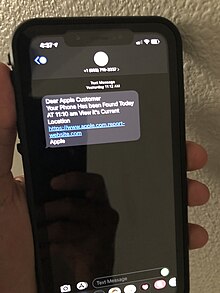
An example of a phishing attack through SMS, showing a fake message and URL challenge to exist from Apple
The Global Service for Mobile communications (GSM), with the greatest worldwide number of users, succumbs to several security vulnerabilities. In the GSM, only the airway traffic between the Mobile Station (MS) and the Base of operations Transceiver Station (BTS) is optionally encrypted with a weak and cleaved stream nada (A5/1 or A5/2). The hallmark is unilateral and also vulnerable. There are besides many other security vulnerabilities and shortcomings.[74] Such vulnerabilities are inherent to SMS as 1 of the superior and well-tried services with a global availability in the GSM networks. SMS messaging has some extra security vulnerabilities due to its store-and-forrad feature, and the problem of faux SMS that tin be conducted via the Net. When a user is roaming, SMS content passes through different networks, perhaps including the Internet, and is exposed to diverse vulnerabilities and attacks. Some other concern arises when an adversary gets access to a phone and reads the previous unprotected messages.[75]
In Oct 2005, researchers from Pennsylvania Country University published an analysis of vulnerabilities in SMS-capable cellular networks. The researchers speculated that attackers might exploit the open functionality of these networks to disrupt them or cause them to fail, possibly on a nationwide scale.[76]
SMS spoofing [edit]
The GSM industry has identified a number of potential fraud attacks on mobile operators that can be delivered via abuse of SMS messaging services. The most serious threat is SMS Spoofing, which occurs when a fraudster manipulates accost data in club to impersonate a user that has roamed onto a foreign network and is submitting letters to the home network. Ofttimes, these messages are addressed to destinations exterior the dwelling house network—with the home SMSC essentially beingness "hijacked" to transport letters into other networks.[ citation needed ]
The only sure way of detecting and blocking spoofed messages is to screen incoming mobile-originated messages to verify that the sender is a valid subscriber and that the message is coming from a valid and correct location. This can be implemented past calculation an intelligent routing office to the network that tin query originating subscriber details from the habitation location annals (HLR) before the message is submitted for delivery. This kind of intelligent routing role is beyond the capabilities of legacy messaging infrastructure.[77]
Limitation [edit]
In an effort to limit telemarketers who had taken to bombarding users with hordes of unsolicited messages, India introduced new regulations in September 2011, including a cap of 3,000 SMS messages per subscriber per month, or an average of 100 per subscriber per 24-hour interval.[78] Due to representations received from some of the service providers and consumers, TRAI (Telecom Regulatory Authority of India) has raised this limit to 200 SMS messages per SIM per mean solar day in case of prepaid services, and up to half dozen,000 SMS letters per SIM per calendar month in case of postpaid services with effect from 1 Nov 2011.[79] However, it was ruled unconstitutional by the Delhi loftier court, only there are some limitations.[80]
Flash SMS [edit]
A Flash SMS is a type of SMS that appears straight on the main screen without user interaction and is not automatically stored in the inbox.[81] Information technology can be useful in emergencies, such as a fire alert or cases of confidentiality, equally in delivering erstwhile passwords.[82]
Silent SMS [edit]
In 2010 Germany, almost half a 1000000 "silent SMS" messages were sent past the federal police, customs and the hugger-mugger service "Verfassungsschutz" (offices for protection of the constitution).[83] These silent messages, also known as "silent TMS", "stealth SMS", "stealth ping" or "Short Message Type 0",[84] are used to locate a person and thus to create a consummate movement profile. They do not evidence up on a brandish, nor trigger any acoustical betoken when received. Their principal purpose was to evangelize special services of the network operator to any prison cell phone.
See too [edit]
- Process Driven Messaging Service
- Comparing of mobile phone standards
- iMessage
- SMS linguistic communication
- Messaging apps
- Text messaging
- Social messaging
- Thumbing
- GSM 03.40
- Short Bulletin Service Center (SMSC)
- Short message service technical realisation (GSM)
- SMS gateway (sending text to or from devices other than phones)
- SMS hubbing
- SMS dwelling routing
- Multimedia Messaging Service (MMS)
- Enhanced Messaging Service (European monetary system)
- Rich Communication Services (RCS)
- Information Coding Scheme
References [edit]
- ^ Kelly, Heather (December three, 2012). "OMG, The Text Bulletin Turns 20. But has SMS peaked?". CNN.
- ^ a b GSM Doc 28/85 "Services and Facilities to be provided in the GSM Arrangement" rev2, June 1985
- ^ a b c Hppy bthdy txt! Dec 2002, BBC News.
- ^ "How SMS Changed the World".
- ^ "When Kickoff SMS Was Sent". Play GK Quiz. Archived from the original on 2017-12-01. Retrieved 27 Nov 2017.
- ^ Blackness, Ken (September 13, 2016). "What is SMS Marketing?". wiseGEEK . Retrieved September 28, 2016.
- ^ Portio Research. "Mobile Messaging Futures 2014-20148". Archived from the original on December 8, 2015. Retrieved 2016-09-28 .
- ^ meet GSM document 02/82 bachelor the ETSI archive
- ^ These Message Handling Systems had been standardized in the ITU, see specifications X.400 series
- ^ See the book Hillebrand, Trosby, Holley, Harris: SMS the cosmos of Personal Global Text Messaging, Wiley 2010
- ^ "Technology". 2009-05-03. Retrieved 14 June 2015.
- ^ Encounter GSM document 28/85rev.2 June 85 and GSM WP1 document 66/86 available in the ETSI archive
- ^ See also Friedhelm Hillebrand "GSM and UMTS, the cosmos of Global Mobile Communication", Wiley 2002, chapters ten and 16, ISBN 0-470-84322-5
- ^ GSM document 19/85, available in the ETSI archive
- ^ GSM document 28/85r2, available in the ETSI archive
- ^ "So who actually did create SMS?". Stephen Temple. 2013-02-24. Retrieved 6 April 2013.
- ^ GSM TS 02.03, Teleservices Supported by a GSM Public Country Mobile Network (PLMN).
- ^ Certificate GSM IDEG 79/87r3, bachelor in the ETSI archive
- ^ GSM 03.xl, WP4 certificate 152/87, available in the ETSI annal
- ^ Finn Trosby, "the strange duckling of GSM SMS" Archived 2007-09-25 at the Wayback Machine, Telektronikk Vol.3 2004.
- ^ MAP phase 1 specification, available from the 3GPP web site.
- ^ MAP phase 2 specification, available from the 3GPP web site.
- ^ CAMEL Phase iii specification, available from the 3GPP web site.
- ^ CAMEL Phase four specification, also available from the 3GPP specification page.
- ^ UK hails 10th birthday of SMS, Dec 2002, The Times of India.
- ^ "First commercial deployment of Text Messaging (SMS)". Archived from the original on March 16, 2008. Retrieved 2017-05-24 .
- ^ U.s.a. Section of Homeland Security. "Cellular Technologies" (PDF). Electronic Frontier Foundation). Archived from the original (PDF) on 2012-05-24.
- ^ "Norwegian History". Telenor Group . Retrieved 2021-04-03 .
- ^ "BT unveils new mobile brand". BBC News Online. 3 September 2001. Retrieved 13 Nov 2021.
- ^ Nael, Merili (2015-06-xxx). "Suri tekstisõnumite looja Matti Makkonen" [Creator of text letters Matti Makkonen died]. Err.ee (in Estonian). Eesti Rahvusringhääling. Retrieved 2015-07-27 .
- ^ a b GSM World press release Archived 2002-02-15 at the Wayback Machine
- ^ Crystal, David (2008-07-05). "2b or non 2b?". Guardian Unlimited. London, UK. Retrieved 2008-07-08 .
- ^ "The World Today – The rise of 3G" (PDF).
- ^ Matthews, Charles H. (Economist) (2015). Innovation and entrepreneurship : a competency framework. Brueggemann, Ralph. (First ed.). New York. ISBN978-0-415-74252-eight. OCLC 893453493.
- ^ Han, Esther (6 May 2015). "Cheaper mobile calls and text every bit ACCC moves to slash wholesale fees" – via The Age.
- ^ "Caktus Group".
- ^ "Libya's Ballot Ushers in New Voter Tech". World Policy Institute. Archived from the original on 2014-07-07. Retrieved 14 June 2015.
- ^ "The death of SMS is exaggerated".
- ^ "98% of the text letters are opened". 27 July 2015.
- ^ GSM 03.40 Technical realization of the Short Bulletin Service (SMS).
- ^ "3GPP specification: 23.040". Retrieved 14 June 2015.
- ^ GSM 03.41, Technical Realization of Short Bulletin Service Jail cell Broadcast (SMSCB).
- ^ "3GPP specification: 23.041". Retrieved 14 June 2015.
- ^ Gil Held: "Data over Wireless Networks." pages 105–11, 137–38. Wiley, 2001.
- ^ https://cs.uwaterloo.ca/research/tr/2007/CS-2007-42.pdf[ bare URL PDF ]
- ^ "Text Message Tips (not sent or received)". community.o2.co.uk. 2018-12-09. Retrieved 2021-09-28 .
- ^ Amri, Kuross. "Advice Networks". Archived from the original on 2016-05-xi. Retrieved 2013-10-05 .
- ^ a b 3GPP TS 23.038, Alphabets and linguistic communication-specific information.
- ^ Groves, Ian (1998). Mobile systems (1st ed.). London: Springer. pp. 70, 79, 163–66. ISBN978-1-4615-6377-8. OCLC 847640648.
- ^ "Does Twilio support concatenated SMS letters or messages over 160 characters?". Twilio Back up . Retrieved 2018-10-29 .
when sending very long SMS messages (longer than x segments with Unicode characters) some mobile carriers may take trouble handling these messages.
- ^ "Simplifying Unicode punctuation for SMS". ssb22.user.srcf.net . Retrieved 2021-07-15 .
- ^ "t-zones text messaging: transport and receive letters with mobile text messaging". T-mobile.com. Archived from the original on 2008-09-17. Retrieved 2008-09-eighteen .
- ^ "Support – How do I compose and transport a text message to a Sprint or Nextel customer from e-mail?". Support.sprintpcs.com. Archived from the original on 2008-10-20. Retrieved 2008-09-18 .
- ^ "Answers to FAQs – Verizon Wireless Back up". Support.vzw.com. Archived from the original on 2008-09-09. Retrieved 2008-09-18 .
- ^ "Is there a maximum SMS bulletin length?". TextAnywhere. Retrieved May 8, 2017.
- ^ Prindle, Drew (December 31, 2016). "How to transport electronic mail to SMS (text)". Digital Trends. Retrieved 2017-05-08 .
- ^ Leyden, John (January 2004). "BT trials mobile SMS to vocalisation landline". The Annals . Retrieved 2017-05-08 .
- ^ Ewan (September 1, 2006). "10pText.co.uk help yous text internationally for 10p/text". SMStextnews. Archived from the original on March 4, 2016. Retrieved 2017-05-08 .
- ^ "Use of Data Last Equipment – Data Circuit terminating Equipment (DTE – DCE) interface for Short Message Service (SMS) and Cell Broadcast Service (CBS)". Retrieved one July 2019.
- ^ "SMS Tutorial: Introduction to AT Commands, Basic Commands and Extended Commands". Retrieved xiv June 2015.
- ^ "Czechs are the first to make charitable gifts past text bulletin". Radio Prague International. 2007-01-eighteen. Retrieved 2021-05-26 .
- ^ "Czechs using novel SMS donation system to aid Indian Ocean victims". Radio Prague International. 7 January 2005.
- ^ USPTO – Usa Patent 7028263 2001
- ^ From Telephone Scoop definitions - Threaded Messaging definition (Phone Scoop) - Retrieved December 29, 2012
- ^ "Whitepaper: Market Opportunities for Text and MMS Messaging" ABI Research, 2011
- ^ "What is A2P (Application-to-person) SMS Messaging? | Glossary". world wide web.infobip.com . Retrieved 2019-04-13 .
- ^ "Long Code Vs Short Code – What'due south The Difference?". Retrieved 23 September 2015.
- ^ "Commercial Long Code SMS Product and Fee Structure Changes on Verizon". Retrieved 17 October 2019.
{{cite web}}: CS1 maint: url-status (link) - ^ "Motorola's ReFLEX Protocol Delivers Wireless Information With Unparelleled N…". 17 July 2012. Archived from the original on 17 July 2012.
- ^ "Report Says That SMS is Not Platonic for Emergency Communications". cellular-news . Retrieved 14 June 2015.
- ^ "Download Limit Exceeded". CiteSeerX10.1.one.76.2465.
- ^ Text Message Delivery Time and Reliability Archived 2011-07-12 at the Wayback Car
- ^ "Report Says That SMS is Not Ideal for Emergency Communications". cellular-news . Retrieved 14 June 2015.
- ^ Solutions to the GSM Security Weaknesses, Proceedings of the 2nd IEEE International Conference on Side by side Generation Mobile Applications, Services, and Technologies (NGMAST2008), pp. 576–581, Cardiff, UK, September 2008, arXiv:1002.3175
- ^ SSMS – A Secure SMS Messaging Protocol for the M-Payment Systems, Proceedings of the 13th IEEE Symposium on Computers and Communications (ISCC'08), pp. 700–705, July 2008 arXiv:1002.3171
- ^ An Analysis of Vulnerabilities in SMS-Capable Cellular Networks: Exploiting Open Functionality in SMS-Capable Cellular Networks (Website) Archived 2005-12-10 at the Wayback Machine
- ^ "An overview on how to stop SMS Spoofing in mobile operator networks (September 9, 2008)". Archived from the original on 2008-09-26. Retrieved 2008-09-12 .
- ^ Nirmala Ganapathy (September 27, 2011). "3,000 SMS a Calendar month Limit in India From Today". Straits Times Indonesia. Archived from the original on February 4, 2013. Retrieved November x, 2011.
- ^ "TRAI extends the 100 SMS per twenty-four hours per SIM limit to 200 SMS per day per SIM" (PDF). Archived from the original (PDF) on November 11, 2011. Retrieved 2011-xi-16 .
- ^ Special Correspondent (2012-01-26). "News / National : TRAI cap on SMS goes". The Hindu . Retrieved 2013-02-24 .
- ^ "SMS types on routomessaging.com". Archived from the original on five May 2013. Retrieved twenty Feb 2016.
- ^ "Wink SMS". Archived from the original on 18 August 2015. Retrieved 14 June 2015.
- ^ "Zoll, BKA und Verfassungsschutz verschickten 2010 über 440.000 "stille SMS" | heise online". Heise.de. Retrieved 2013-02-24 .
- ^ "3GPP TS 51.010-one version 12.5.0 Release 12" (PDF). ETSI. September 2015. pp. 3418–3423. Retrieved 2017-04-23 .
External links [edit]
 | Wikimedia Eatables has media related to SMS. |
- 3GPP – the arrangement that maintains the SMS specification
- ISO Standards (In Cipher file format)
- GSM 03.38 to Unicode – how the GSM 7-bit default alphabet characters map into Unicode
Source: https://en.wikipedia.org/wiki/SMS

Post a Comment for "When My Messages Go in Order by the Native Id Does Mean They Ate Read?"